In 2009, Kadima finished first in the Israeli election, with 28 seats to Likud's 27. The prime minister who emerged was Benjamin Netanyahu, leader of the second-placed party.
Nothing improper happened, and nothing unusual by Israeli standards. Kadima won the most seats; Likud won the most reachable seats; and in Israel those are different quantities. Netanyahu could assemble 61. Tzipi Livni could not. The election had produced a parliament; the parliament produced a government; the two processes gave different answers, and only the second one governs.
Twelve years later the gap was wider still. In 2021, Likud finished first with around thirty seats — more than ten clear of the runner-up. The prime minister who emerged led a party with seven.
If you take one idea from this site, take this one: in Israel, finishing first does not settle who governs. A named group reaching 61 seats has an outright parliamentary majority. That is a useful question for a forecast, even though it does not settle who can form a government.
The record
The 2009 result was not an anomaly. The pattern — a plurality that fails to translate into a government — recurs across four decades, under different party systems and even under a different electoral law.
| Election | Largest party (seats) | Who governed |
|---|---|---|
| 1984 | Alignment (44) | Deadlock. A national-unity government with a rotating premiership between the two largest parties. |
| 1996 | Labor (34) | Benjamin Netanyahu (Likud, 32), elected on a separate direct ballot for prime minister. When his government later fell, Labor — still the largest party — backed dissolving the Knesset rather than attempt a coalition it could not assemble. |
| 2001 (prime minister only) | No Knesset election; the existing chamber remained in place | Ariel Sharon won a special direct election for prime minister and formed a broad coalition — while leading a Likud faction of roughly 19 seats. |
| 2009 | Kadima (28) | Benjamin Netanyahu (Likud, 27). |
| Apr 2019 | Likud (35, tied with Blue and White; ahead on votes) | No one. The Knesset dissolved itself without a government being formed. |
| Sep 2019 | Blue and White (33) | No one. A third election followed. |
| 2020 | Likud (36) | No conventional coalition. An emergency rotation government formed, and collapsed within a year. |
| 2021 | Likud (30) | A coalition assembled without it, headed first by the leader of a seven-seat party. |
The 1996 and 2001 entries need a separate reading. In 1996, voters elected both a Knesset and a prime minister on separate ballots. In 2001, a special election chose only the prime minister; the Knesset was not elected again. These cases illustrate the distance between party size and the premiership, but the 2001 row is not another Knesset election result.
The record runs in both directions. Plurality is not sufficient: Likud tied for the most seats in April 2019, while Blue and White led it 33–32 in September; neither election produced a government before another vote was called. Plurality is not necessary either: governments have been led from the second-largest party, and once from a party of seven seats. What decides who governs is whether a proposed government can win the Knesset's confidence and survive the politics that follow.
What 61 measures
The Knesset has 120 members, so 61 seats give a defined group an outright majority. It is a clear benchmark for the parliamentary balance, not a legal requirement that every new government receive 61 votes in its confidence vote. In June 2021, the 36th government took office after a 60–59 vote with one abstention.
The distinction matters in both directions. A group with fewer than 61 seats may still install a government if enough other members abstain or support it. A group with 61 seats on paper may never agree on a government. Replacing a sitting government through a constructive no-confidence motion is different again: Basic Law: The Government requires a majority of all Knesset members to express confidence in an alternative government.
We track 61 because it identifies an unambiguous seat majority. We do not turn that seat count into a probability that negotiations will succeed.
Seats are a step on the way to a government
Here is how the calculation works:
votes → threshold → seat allocation → named groupings → chance of 61 seats
Most election coverage reports the seats won by each party and leaves you to examine the possible groupings yourself.
But 32 seats has no fixed political meaning. Thirty-two seats inside a grouping that reaches 63 are part of a clear majority. Thirty-two seats inside a grouping that stalls at 59 are not. The same number, the same votes, and different parliamentary possibilities — because the seats held by other parties also matter.
This is why a forecast expressed only as individual party seat counts can miss an important question. A model can get one party's seats right and still be silent on the majority prospects of a defined grouping.
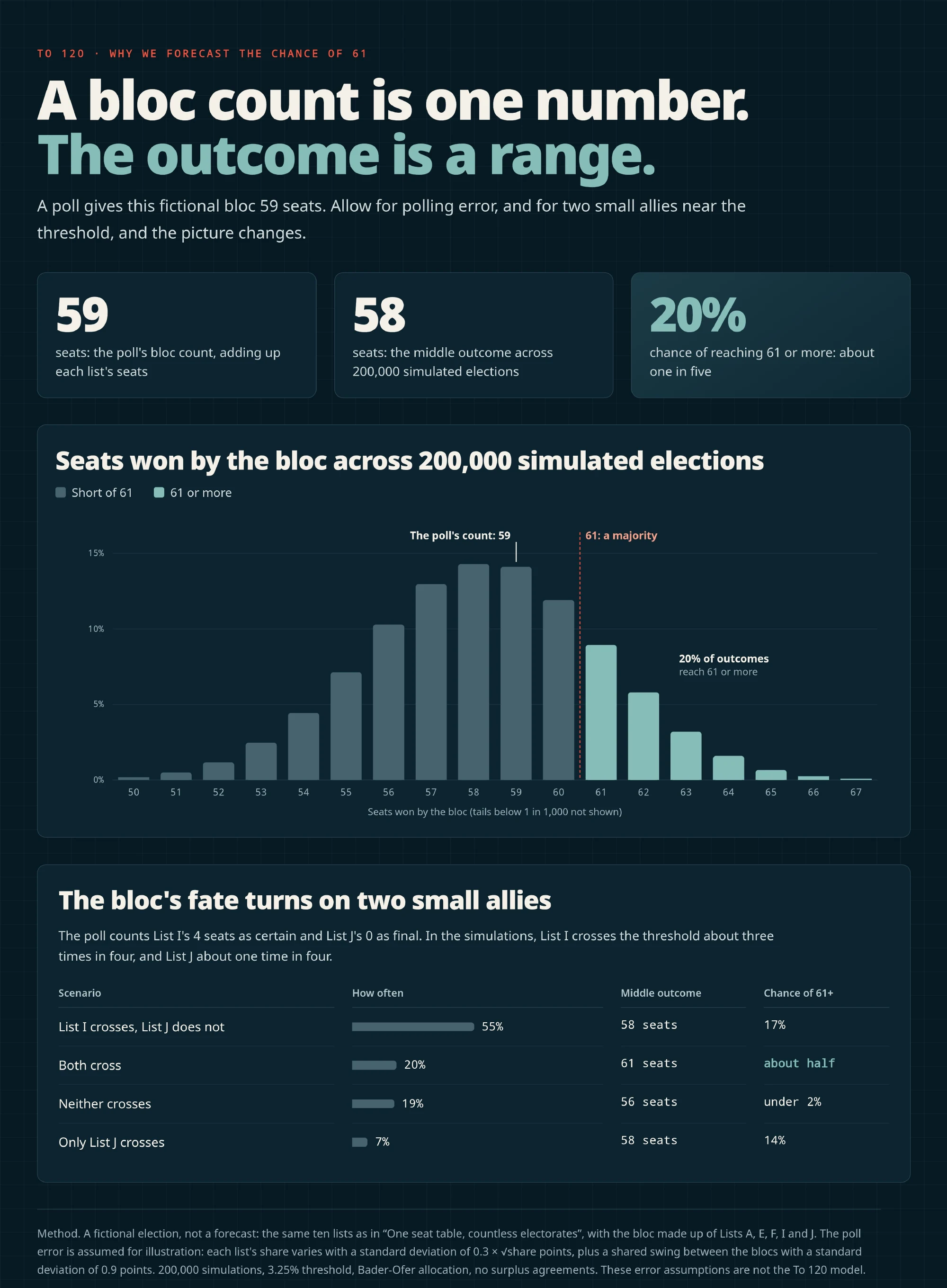
Our headline output is the probability that a named grouping reaches at least 61 seats in the simulated results. It is a forecast about the parliamentary arithmetic, not the eventual government.
What a "bloc" is, and why it is harder than it sounds
A bloc in the forecast is a named set of lists whose seats are counted together. Some groupings represent a possible political alignment; others are arithmetic scenarios that test what the numbers would allow.
Reader intuition here usually reaches for left and right. That intuition will fail you, and we have a separate article on why. For present purposes: the dominant Israeli cleavage for the past several cycles has not been primarily economic. It has run through questions about one man's continued premiership, about religion and state, about the judiciary, and about which communities are considered legitimate coalition partners at all. Parties that agree on taxation to the decimal point have refused to sit together. Parties with no shared programme have governed jointly for a year.
Political compatibility cannot be deduced from a seat total. Parties' public statements about potential partners help explain the scenarios, but such statements can change. Each grouping must therefore be read with its stated membership and assumptions, especially when it is presented only as an arithmetic possibility.
"Counts toward 61" is not a single question
This is the part most coverage flattens.
When someone says a party "counts toward 61," they may mean several different things. Will it sit in the cabinet, sign the coalition agreement, and take portfolios? Will it vote to install a government from outside, without joining it — an arrangement Israel has used before? Or does it count only in the negative sense: by winning seats and withholding its recommendation, a party can make the rival path impossible without ever supporting anyone itself. Blocking of that kind is the cheapest form of power in the system, and the most commonly overlooked.
These are genuinely different questions, and for some parties they carry different answers at the same time — honestly, and without anyone misleading anyone. A single bloc total collapses those distinctions into one number, and something real is lost in the collapse.
The forecast names each seat grouping it calculates and labels combinations that are arithmetic only. Its majority probability describes the chance that the named grouping holds at least 61 seats in the simulated results. It does not estimate whether those parties would agree to form, install, or support the same government.
Why the smallest parties decide the largest question
Because 61 is a clear seat-majority line and the electoral threshold gives a list either representation or none, small lists can substantially change a grouping's chance of reaching it.
Consider the mechanics. A list polling near 3.25% either takes roughly four seats or takes zero. If it takes four inside your bloc, your bloc gains four. If it takes zero, its votes are excluded from the pool used to allocate seats — and this is the part that catches people out, because the four seats it would have held are not left vacant. They are allocated among the lists that did cross under the seat-allocation rules.
So the failure of a small ally is not a four-seat loss for its bloc. It is worse in one respect and better in another. Worse, because some of those four seats cross the aisle. Better, because the bloc's own larger parties claw a portion back. The net cost to a bloc is roughly four seats multiplied by the opposing bloc's share of the qualifying vote — in practice, two to three seats, moved by a party that never appeared in a headline, on a shift of a few tenths of a percentage point.
The gap between the two blocs, meanwhile, moves by about twice that. Which of the two figures you should care about depends on the question. If you are asking whether a bloc reaches 61, the bloc's own total is the one that matters. We report that one.
This is an important source of uncertainty, and it is why our threshold coverage is as prominent as our seat coverage. A comfortable-looking bloc total can describe only one branch of an election when a list sits near 3.25%.
What this means for how you read this site
Three habits, if you want to read Israeli polling well:
Ask what the majority number represents. Check which lists are included in each route to 61 and whether that route is a political alignment or only an arithmetic scenario.
Watch the parties near the line. A small shift around 3.25% can change whether a list receives any seats at all; a shift of the same size elsewhere need not have that effect.
Check the assumptions behind a bloc total. It depends on which parties are included and why they are grouped together. Whether they would work together is a separate question.
Israeli election night produces a number for every party. This site estimates whether named combinations reach 61 seats; who actually governs is decided afterward.