Two parties finish an Israeli election. One takes 3.1% of the vote. The other takes 3.4%.
The gap between them is three votes in a thousand. The gap in outcomes is four seats and zero seats.
Proportional representation is supposed to be the system without cliffs — the one where a small change in support produces a small change in power. Israel's is, across almost its entire range. A list that gains half a point gains roughly half a point's worth of Knesset. Everywhere except one place.
At 3.25% of valid votes nationwide, that gradual relationship stops. Below the line a list wins no seats. At or above it, a list wins at least four. There is no partial representation below the threshold.
That sudden jump is one of the main reasons Israeli elections are hard to forecast.
Why the minimum is four
The arithmetic is quick. The threshold is 3.25% of valid votes; the Knesset has 120 seats; 3.25% of 120 is 3.9. A list that clears the bar is entitled to a proportional share of at least 3.9 seats, which after allocation means four.
So Israel has no one-seat parties and no two-seat parties. The smallest possible faction is four members, and it got there by winning something in the neighbourhood of 150,000 votes and only just.
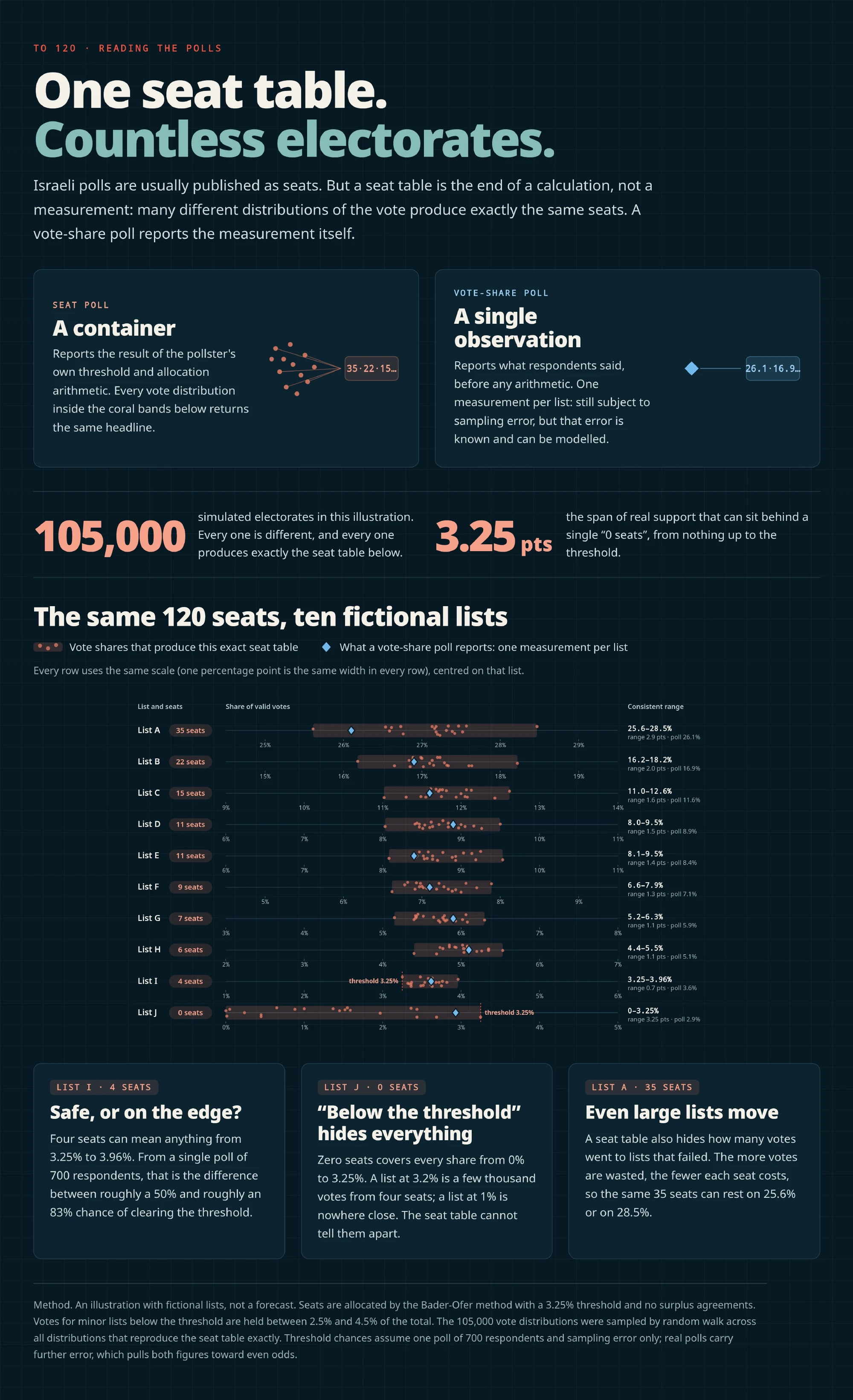
This has a strange consequence for how you should read polls. When a survey shows a list at "4 seats," that is not a measurement of weakness in the ordinary sense. It is the system's way of saying this list exists. The number below 4 is 0. There is nothing in between to report.
Where the number came from
The bar has been raised three times, and each increase changed the incentives for smaller lists.
Israel began with a threshold of 1%. It rose to 1.5% for the 1992 election, to 2% under a law passed in 2004, and to 3.25% under a law passed in 2014, taking effect from the 2015 election onward. The Knesset's threshold history records the three increases.
Supporters of higher thresholds have argued that fewer factions make governing easier. Opponents have warned about lost representation, especially for smaller groups. After the 2014 increase, the main Arab-majority parties ran together as the Joint List in 2015 and became the third-largest faction in the Knesset. The rule thus affected both entry into the Knesset and the decisions parties made before voting began.
Whatever you make of the motives, the threshold is a political choice made by the sitting Knesset. Its effects reach beyond the lists that ultimately fall short.
The votes are discarded. The seats are not.
This is the part that surprises people, and it is the reason the cliff is worth more than the seats directly at stake.
Be precise about the mechanism, because the loose version of it is wrong and gets repeated constantly. A failed list's votes are not handed to anybody. They are simply excluded — struck from the pool before allocation begins, as though they had never been cast.
What matters is what that exclusion does to the arithmetic. Israel allocates seats using a quantity sometimes called the measure: the total votes cast for lists that cleared the threshold, divided by 120. That is the price of a seat. Remove 150,000 votes from the numerator and the price of a seat falls. Every surviving list now buys more seats with the same votes.
The Knesset still has 120 members. The four seats the failed list would have occupied are still filled — by everyone else, in proportion to their size.
Here is that happening in two illustrative results with roughly 4.1 million valid votes. One list is at 3.34% in the first result and 3.08% in the second; the example isolates the seat-allocation effect of crossing the threshold and omits surplus agreements.
| List | If it crosses | If it misses | Change |
|---|---|---|---|
| Largest list, opposing bloc (28.0%) | 34 | 36 | +2 |
| Second list, opposing bloc (12.7%) | 15 | 16 | +1 |
| Largest list, its own bloc (17.5%) | 21 | 22 | +1 |
| The list on the cliff | 4 | 0 | −4 |
| Opposing bloc total | 69 | 72 | +3 |
| Its own bloc total | 51 | 48 | −3 |
The price of a seat falls from about 34,200 votes to about 33,100. Half the freed seats go to the single largest list in the parliament.
Two things follow, and both are usually stated badly.
A near-miss does not cost its bloc four seats. It costs four, then returns a proportional share — here, one seat back to its own side. The net was three. The general rule: the cost to a bloc is roughly four seats multiplied by the opposing bloc's share of the qualifying vote.
The gap between blocs moves by roughly double the net. Three seats lost by one side and three gained by the other is a six-seat swing in the differential. Both numbers are real; they answer different questions. If you are asking whether a bloc reaches 61, use the first.
Israel has run this experiment repeatedly.
In April 2019, the New Right, led by Naftali Bennett and Ayelet Shaked, received 138,598 votes out of 4,309,270 valid votes. The 3.25% threshold required at least 140,052 votes, so the list missed by 1,454 votes. Its votes were excluded from seat allocation, and the country voted again in September.
In 2022, Meretz received 3.16%, just 0.09 percentage points below the threshold, while Balad received 2.91%, 0.34 points below it. Both won zero seats; their combined votes were excluded from the pool used to allocate the 120 seats. They were not interchangeable coalition partners, but both results affected the parliamentary arithmetic. Official 2022 results.
These examples show why the location of a small list relative to 3.25% matters: a small difference in vote share can mean a jump from representation to zero, with effects across the seat allocation.
What the cliff does to campaigns
A rule this sharp does not sit quietly in the background. It reshapes the whole strategic environment.
It encourages mergers. Two lists at 2.5% each would both miss the threshold separately. If a joint list retained all their voters, it would be above the line; whether it actually would retain them is a political question. This incentive helps explain negotiations among smaller parties before the list-submission deadline.
It can change campaign behaviour. A poll showing a party at 3.0% may lead supporters to reconsider their votes or encourage other supporters to rally to it. The direction and size of any such response cannot be read from the poll alone.
It raises the stakes of small changes. Half a percentage point in a party near 3.2% can change whether it enters the Knesset, although that does not by itself determine which government will form.
Why this makes forecasting hard — and how we handle it
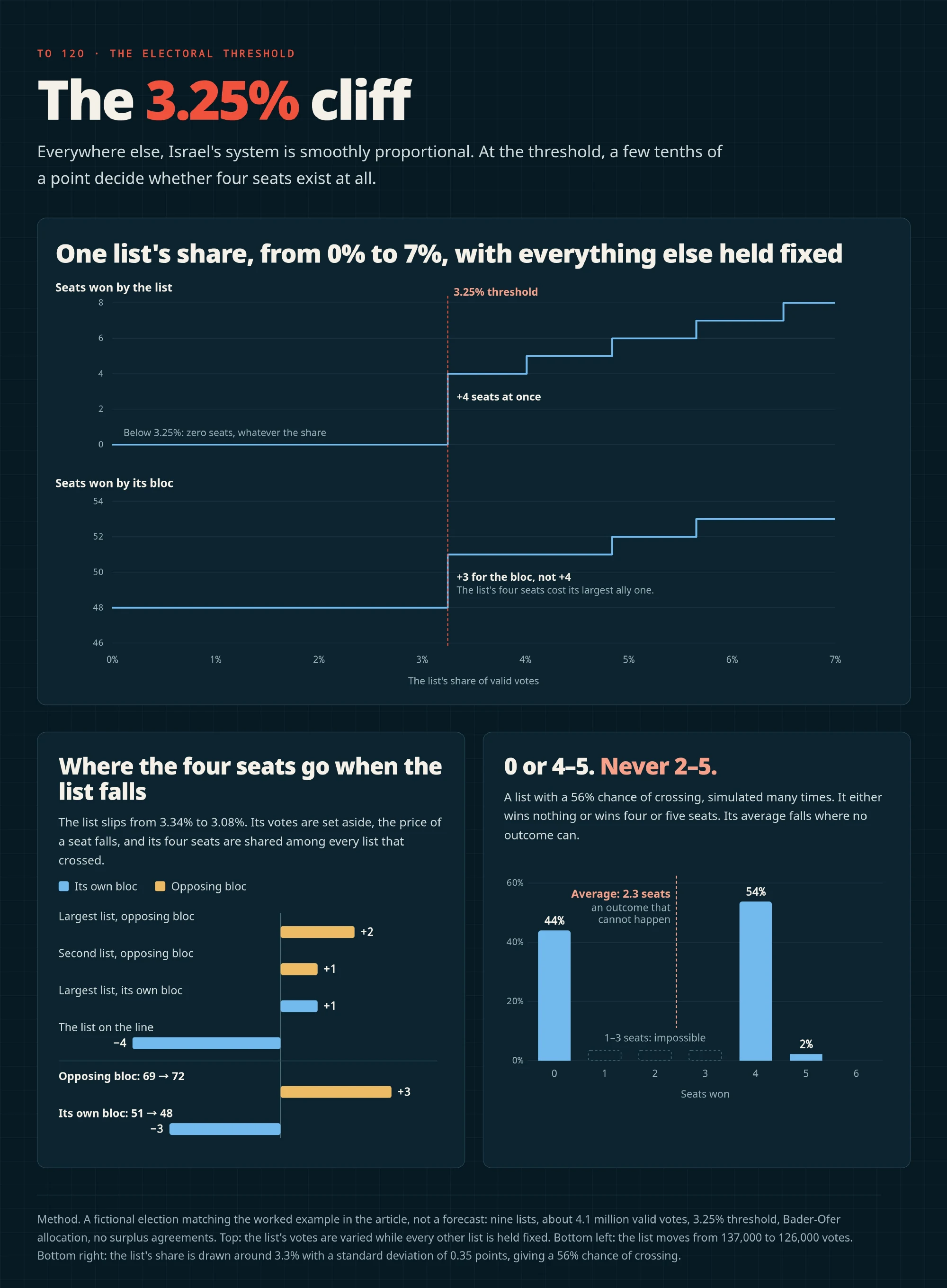
A party near the threshold faces two very different possibilities: no seats, or at least four. It may have a real chance of either outcome, while one, two, or three seats are not possible under these rules.
That makes an average misleading on its own. If a party has a 50% chance of taking zero and a 50% chance of taking five, its average is 2.5 seats. The calculation is correct, but 2.5 seats is not a possible election result.
For a list near the threshold, two figures are more useful than an average alone:
- the probability of crossing, on its own, as a probability; and
- the seat range if it passes the threshold.
For example, 0 or 4–5 keeps the two possibilities separate. A range of 2–5 would include seat counts that cannot happen, and hide the risk of no representation.
The same issue affects bloc totals. A small list passing or missing the threshold can produce two groups of outcomes several seats apart. The bloc’s results may therefore look quite different from a smooth bell curve. A range alone can hide this; the chance of reaching 61 and the small list’s chance of entering the Knesset help explain it.
This is where a forecast can help. It estimates possible vote shares, checks which lists pass 3.25% in each simulated election, divides the seats, and counts how often each named grouping reaches 61. We must then check these chances against real results over time.
What to watch
Late in a campaign, ignore the top of the table for an hour and look at the bottom.
Count the lists between roughly 2.5% and 4.5%, then check which groupings include them. Several lists in that band can make a majority forecast sensitive to small shifts, especially when one grouping reaches 61 only if a particular list crosses.
Then check which side they are on. A cliff that threatens one bloc's small partners and not the other's is not a symmetric risk, and the headline seat totals will not tell you that.
Israel's electoral system is proportional across much of its range. The 3.25% line introduces a sharp change in representation, which is why this forecast gives it particular attention.