The main number on this site is a probability: the estimated chance that a named group of parties reaches 61 seats in the next Knesset. On any given day that number might read 30%, or 55%, or 80%.
This article explains what such a number commits us to, what it does not, and — most importantly — how you should judge us once the election has happened. We are writing it before the results are known, deliberately. A forecaster who explains the rules of evaluation only after the outcome is in has too much room to explain selectively.
A probability is a statement about odds, not a prediction
When we publish "30%," we are not predicting that the event will not happen. We are stating that, given everything the model can see — the polls, their history of error, the threshold arithmetic, the coalition structure — the event should occur in roughly three out of ten situations that look like this one.
Three out of ten is not rare. Events with a 30% probability happen constantly. If you commute in a city, you encounter 30% events several times a week. A batter with a .300 average is having an excellent season. Rain forecast at 30% still means you sometimes get wet.
It follows that a 30% event occurring is not, by itself, evidence that the forecast was wrong. And a 70% event failing to occur is not, by itself, evidence of failure either. A single outcome cannot validate or refute a probability. This is not a convenient excuse invented by forecasters; it is a basic property of what a probability is.
Which raises a fair question: if no single result can prove us wrong, what stops us from being unaccountable?
The standard we accept: calibration
The answer is to check many forecasts over time. This is called calibration: do events given a particular chance happen about that often?
Collect every statement a forecaster makes at a given probability level. Of all the events we assign roughly 30%, about 30% should actually occur. Of the events we call at 80%, about eight in ten should happen. A forecaster whose "80%" events occur only half the time is overconfident. One whose "80%" events occur 97% of the time is underconfident — hedging with numbers that were less certain than the evidence justified. Both are failures, and both are measurable.
This is the standard we hold ourselves to, and it has a practical consequence you should hold us to as well: we are judged over many outcomes, not one night. Daily forecasts about the same election result are repeated estimates of one outcome, not independent tests. Party thresholds, seat totals, and bloc majorities within one election can also move together. A useful evaluation must account for those dependencies and accumulate evidence across election cycles.
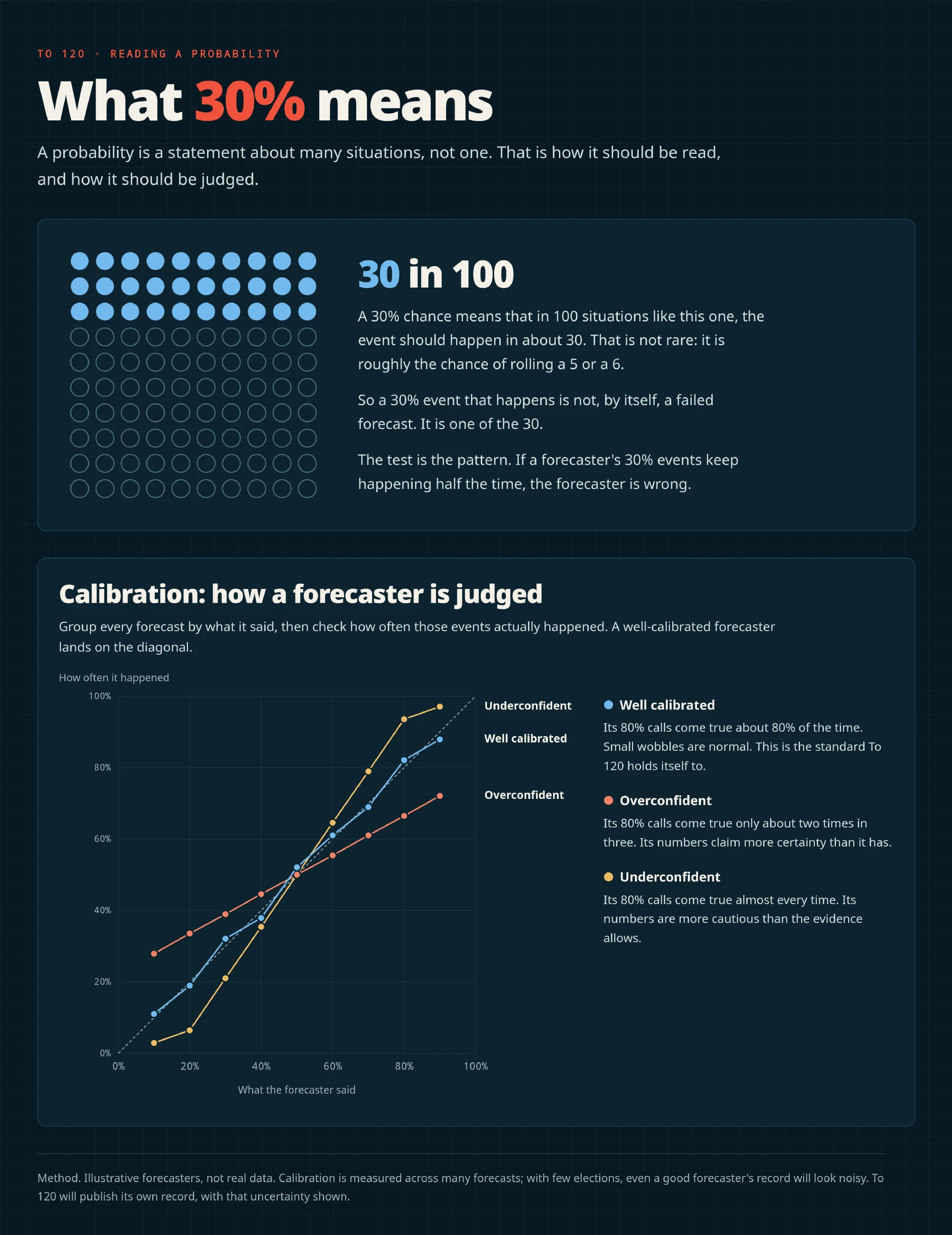
We commit to publishing that record — the probabilities we stated, when we stated them, and what happened — in a form that can be checked without trusting us.
Why Israeli elections make probability unavoidable
In many electoral systems, a point prediction — "this party will win 32 seats" — is imprecise but serviceable. In Israel there is a structural reason it can be worse than imprecise: it can be meaningless.
The reason is the electoral threshold. A list needs 3.25% of the valid national vote to enter the Knesset. Below that line it receives zero seats; just above it, at least four. There is nothing in between.
Now consider a list whose polling places it at roughly even odds of crossing. What is the correct seat prediction for that list? Its average outcome is about two and a half seats — a number that cannot occur. Publishing it would be presenting a false precision: technically defensible arithmetic describing no possible result.
A clearer description has two parts: the chance of passing the threshold, and the seat range if it passes. That is why a range such as "0 or 4–5" is more useful than "2–5." It shows both the possibility of no representation and the possible seats if the list enters the Knesset.
The same logic runs upward into the headline number. A bloc's path to 61 often depends on whether one or two small lists cross the threshold. In that situation the bloc's seat total is not a bell curve around a central value; it is a small set of distinct scenarios, each fairly well defined, separated by several seats. A probability over those scenarios is not a hedge. It is the only accurate summary available.
How to use the number
Some practical guidance for reading a figure like "Bloc A: 70% to reach 61."
Do not round it to certainty. Seventy percent means the other outcome occurs three times in ten. If you are planning or writing on the assumption that the 30% side is a live possibility, you are reading the forecast correctly, not being contrarian.
Do not treat 50% as ignorance. A well-supported 50% is a finding, not a shrug. It says the evidence genuinely balances — which, in an election that hinges on a threshold event, is often exactly the true state of affairs. A forecaster who never says 50% is not more informed; they are less honest about close situations.
Watch movement with some suspicion, including in our own numbers. A one- or two-point change in a daily probability may reflect ordinary variation in the incoming polls; its size alone cannot establish whether opinion has changed. We will try to show the change alongside the uncertainty around it.
And keep the questions separate. "Who will get the most seats?", "will this named grouping reach 61 seats?", and "who will govern?" can have different answers. Our probability addresses the middle question, not the negotiations or confidence vote that decide the last.
What our numbers are not
A few disclaimers that we would rather state now than after the fact.
The probability is not a vote share. "Bloc A: 70%" does not mean 70% support; it means seven in ten odds of reaching a majority. The two are routinely confused in coverage of forecasts, and the confusion flatters no one.
The probability is not a measure of momentum, enthusiasm, or deserved victory. It is an estimate of odds under a stated method, nothing more.
And this forecast does not claim to predict seat counts better than the polls it is built on. That claim would require evidence we do not have: Israeli elections are rare, the recent record offers only a handful of validation points, and no responsible method can demonstrate a point-accuracy advantage from a sample that small. What we do claim is narrower and, we believe, more useful — that we translate the polls into probabilities honestly: carrying poll error at its historically observed size rather than an optimistic one, propagating the threshold's all-or-nothing arithmetic correctly into bloc totals, and reporting the resulting uncertainty instead of smoothing it away.
What would count as failure
You should know in advance what would make this forecast wrong by its own standards, so that the standard cannot move afterward.
A single surprising result would not. A repeated pattern would: if events we give an 80% chance fail far more often than expected, or events given 20% happen far more often, our stated chances may be unreliable. We will check that while remembering that repeated daily estimates of the same election are not separate tests.
Honesty also requires stating the limit of the test itself. With few elections, even a well-calibrated forecast will show noisy results, and even a flawed one can get lucky. Our calibration record will accumulate slowly, and we will present it with the uncertainty that a small sample carries, because the alternative — implying a precision the data cannot support — is the exact failure this article is asking you to watch for.
A probability is an instrument reading. It should be judged the way instruments are judged: not on whether one reading was followed by rain, but on whether, over time, its readings and reality agree.