Begin with the feature that most distinguishes the Israeli system: it has no electoral geography.
Israel has no districts. No constituencies, no ridings, no swing states. No safe seats, because no seat is attached to a place. No gerrymandering, because there is no map to draw. No local candidate on your doorstep, because your locality elects nobody. And no way to vote for a person: the ballot offers lists, and the order of names on each list was settled before you arrived.
Readers from systems that divide seats roughly in proportion to votes will find much of this familiar. Voting for a party list, a minimum vote share to win seats, and negotiations to form a government are common across Europe. Israel takes the national approach further. Many proportional systems also have regional lists or locally elected members, and many let voters choose individual candidates within a list. Israel has neither: the whole country votes in one district, and voters cannot change the order of candidates on their chosen list.
If you arrive looking for the marginal seats that will decide the election, there are none to find.
Every valid vote cast anywhere counts identically toward the same national tally. A vote in a Tel Aviv high-rise, a Negev village and a Golan kibbutz are, arithmetically, the same vote. That simplicity at the front end is what produces the complexity at the back.
The ballot
You walk into a polling station, show ID, and step behind a screen. In front of you is a tray of small slips of paper. Each slip carries a short Hebrew letter code — one, two, or three characters — and, beneath it, the name of a list. You take one slip, put it in an envelope, seal it, and drop it in the box.
That is the entire act. One slip, one list, no ranking, no preferences, no second choice, no write-in.
The letter codes are worth a moment. They are not initials in any consistent sense; they are assigned identifiers that parties fight over, inherit, and occasionally trade. The familiar codes make lists easier to recognize on a ballot where the voter selects a slip rather than marking a candidate's name.
The list is closed, and it was written before you got there
The slip you dropped in the box was a vote for an ordered list of up to 120 names. If the list wins nine seats, the first nine names on it enter the Knesset. If it wins four, the first four do.
Your general-election ballot gave you no say in the order. Party members may have had a say earlier, if the party chose its candidates through primaries.
How that order gets set varies enormously. Some parties hold membership primaries. Some have a central committee vote. Others leave the decision to a small leadership group. A candidate's place on a list can matter as much as the list's vote total to that candidate's chance of entering the Knesset.
The practical consequence for a voter: the general-election ballot cannot single out an individual politician for a reward or penalty. Your vote goes to the list that carries them; the candidate you like at number 12 arrives only if the whole list wins at least 12 seats.
Lists are finalized well before election day — roughly seven weeks out, when the slates are formally submitted to the Central Elections Committee. Everything before that deadline is negotiation: mergers, splits, defections, and the surplus-vote agreements that we cover separately. Everything after it is campaigning against a fixed board.
One district, one national count
When polls close, votes are counted at the ballot-box level and aggregated nationally. There is no seat-by-seat drama, no early-reporting county to extrapolate from, no incumbent losing their own patch. There is one number per list, growing through the night.
Two things then happen to that number, in order, and both are ruthless.
First, the threshold. Any list that fails to reach 3.25% of the valid national vote receives nothing. Not a reduced share — nothing. Its votes are removed from the pool entirely, as if they had not been cast. Because 3.25% of 120 seats is 3.9, a list that clears the bar receives at least four seats. There is no such thing as an Israeli party with one or two seats. The cliff is the single most important structural feature of the system, and it has its own article.
Second, the seat calculation. The votes for lists that passed the threshold are used to divide the 120 seats. After an initial division, the remaining seats are assigned one at a time under the Bader-Ofer method. Pairs of lists can sign surplus-vote agreements before the election, letting them compete together for these remaining seats. An agreement can affect the final seat totals without making the parties political allies.
By the early hours, the arithmetic produces 120 numbers that sum to 120.
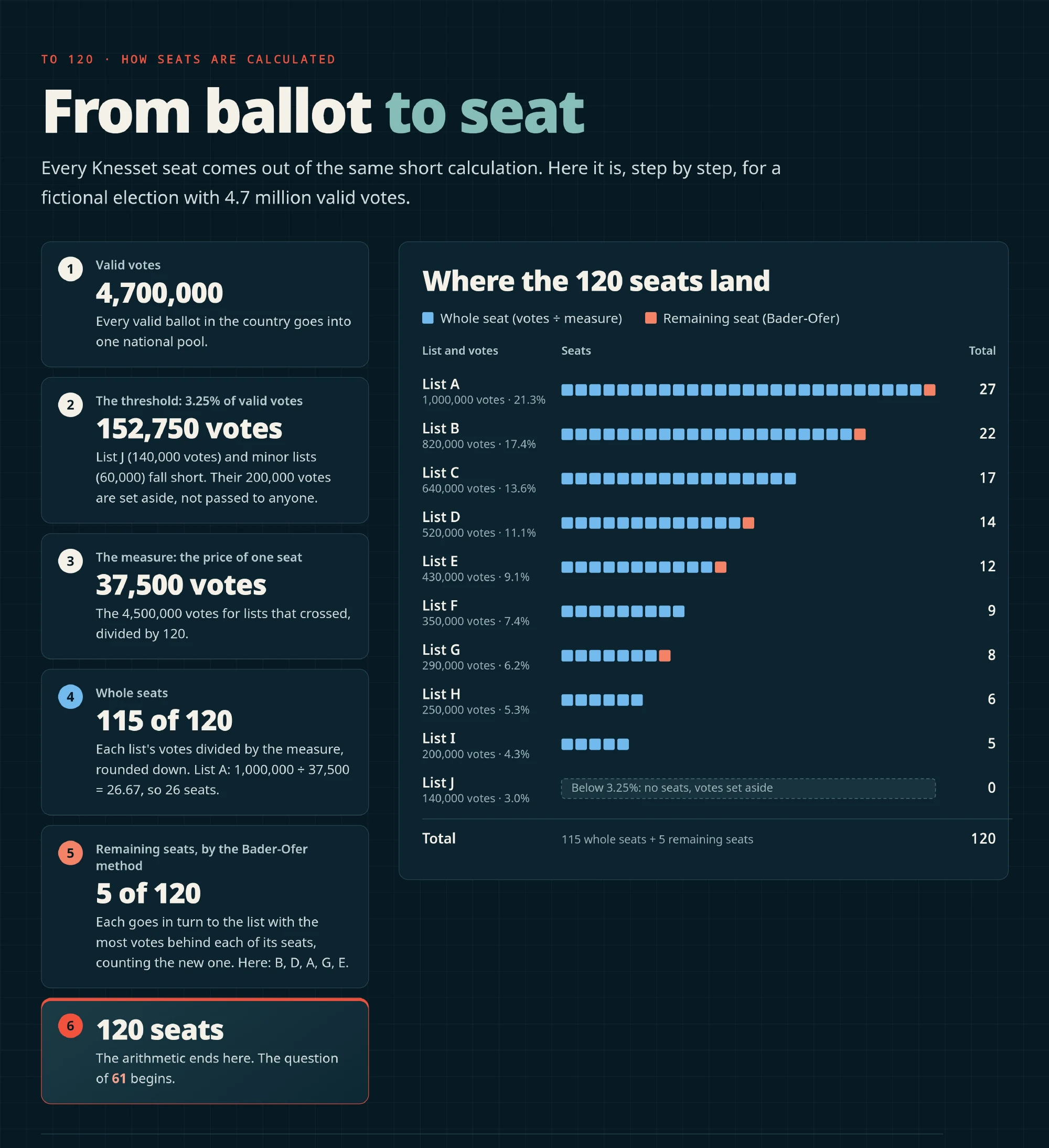
And then the actual election begins.
From parliament to government
As in any parliamentary system, the count does not select a head of government. The Knesset does that, or fails to.
After results are certified, the President consults every faction in the new Knesset and asks each one whom it recommends. The President then tasks one member — usually, but not necessarily, whoever appears to have the clearest path — with forming a government. That member has 28 days, extendable by 14. If they succeed, the proposed government must win the Knesset's confidence. That vote does not always require 61 members voting in favour: the 36th government was approved 60–59, with one abstention. If the attempt fails, the Basic Law sets out further opportunities to form a government and, failing that, a new election.
Between 2019 and 2022, this happened five times.
Israel is one of the few parliamentary democracies to have tried the alternative and abandoned it. From 1996 to 2001, voters cast two ballots: one for a party list, one directly for prime minister. The result was a directly elected leader whose parliamentary base had been hollowed out by voters now free to split their tickets — the premiership gained a mandate and lost a majority. The law was repealed. The episode is worth keeping in mind whenever someone proposes a clean structural fix to Israeli coalition politics.
Election day itself
Election day is a national holiday. Workplaces close, the beaches fill, and turnout is high by developed-democracy standards — recent cycles have run in the high sixties to low seventies as a share of the register.
Voting is overwhelmingly in person and in your assigned station. There is no general postal or absentee ballot. A limited set of voters — soldiers, diplomats, prisoners, hospital patients, merchant seamen — vote by a "double envelope" procedure whose ballots are verified and counted separately, and later. These are the votes that keep arriving after the initial count and that have, on occasion, moved a seat. If you are watching returns and wondering why the numbers keep twitching two days later, this is why.
Exit polls are published the moment stations close, they are treated as news, and they have been wrong often enough that treating them as results is a mistake with a long Israeli history.
Why this matters for reading a forecast
If you are coming from a district-based system, one adjustment is worth making explicitly, because it runs in a consistent direction: district intuitions make an Israeli election look more decisive than it is.
In a district system, a national vote swing converts into a change of government through a chain of local contests, and the largest party usually ends up governing. In Israel, the vote converts into a proportional parliament, and the parliament converts into a government through negotiation. The first conversion is arithmetic. The second is politics, and it does not reliably favour the largest party.
If you are coming from a PR system, the mechanics will already be familiar and the adjustment is narrower: Israeli coalition arithmetic is unusually constrained, because several sizeable blocs rule each other out in advance rather than bargaining. That is what turns an ordinary parliamentary system into one that produced five elections in four years.
Either way, the consequence for reading a forecast is the same. A number like "Party X: 32 seats" is not a result. It is an input to a result.
For the forecast, 61 is the benchmark for an outright seat majority. Government formation remains a separate political and parliamentary decision.